
Welcome back everyone and I apologize for the delay, there was this tornado warning and I was volunteering to help with damage that was caused by the strong straight winds that came through.
With that out of the way, today we’re talking about the best and worst of Arcade games, a very brief guide to some of the worst games out there that you shouldn’t bother with if you find yourself at an arcade or old bowling alley with a game in the back that could either eat your quarters or gave you a couple hours of entertainment.
So without further delay to a simple list of games, I’ll simply do 5 of the best and 5 of the worst, to keep things simple and because you’re very unlikely to see one of these bad games compared to the many popular games that are much better in quality.
Starting with the best games at number five we have Dig-Dug. I’ve talked about this game in the past. It’s different compared to others which is why it’s so low on this list. Compared to something like a racing game that anyone could pick up in a couple seconds or pac-man which is easy to understand, the idea of having to move around, making sure not to get smashed by rocks, keep track of the increasing amount of enemies that also get faster, and first time players or intermediate players still not having any sort of strategy to consistently get better, it’s definitely a more challenging game.

The object is simple: dig through and pop enemies, score points, gloat about your score. This is personally my favorite arcade game, with my goal at a local barcade is me having my name up on the big board they have there. While this game is low on this list for all time best, it’s probably my favorite arcade game.
Next up at number four is Galaga. This game can be hit or miss for some in terms of skill. I myself never score well (the 30,000’s maybe) while my buddy will get double the score with ease. I’m not sure what is it that causes the huge gap in skill, but people out there exist who are just great at this game. That gap in skill is what landed this game in the 4th spot. While the game is much easier to pick up, the risk/reward of getting a double ship for twice the firepower at the risk of losing another life, enemies adopting kamikaze ideals in order to destroy you while also firing at you, the game can become chaotic quickly if you don’t stay calm, have a good aim, and a steady hand.

The number three spot goes to the original Donkey Kong. A simple game with a simple concept, dodge, jump, and get the girl back as an unnamed plumber at the time. This game has random barrels, later on fire, jumps across hazardous gaps and changing levels. If you play this game, you probably understand how it works. Most new players wouldn’t jump straight into this game as their first choice compared to others, as it can be difficult. However the object of the game is simple enough that if someone were to walk up to the machine they could clear a couple levels and after getting over would say “hang on let me try that again” because of how fun the challenge that is present can be.

Oh look it’s number two, and it was mentioned earlier. That’s right, with no surprise that it’s on the list, it’s Pac-Man. This game is probably the most simple to play of those mentioned this far: collect pellets, dodge ghosts. Just about anyone could do it, it’s not till the later levels when things get faster than you need to have a strategy in mind, but for a kid with a couple quarters, someone who’s never played, or someone who’s had a few drinks at a barcade, it’s fun for everyone.

The number one game though in my opinion is the original Mario Bros. While it may take a little time getting used to with the slightly slippery controls (which doesn’t help later on in stages that actually have ice), the reason why it becomes number one is because you can get help from a friend! As silly of a reason it may be, being able to get help from a friend is a huge advantage: get farther in the game, fight for high scores, no waiting to take turns. The game is pretty simple and generous, just be on the lookout later on for fireballs that can go across different parts of the stage or the increasing speed of enemies as stages progress. It all becomes much more manageable with another friend to help.

Well, now let’s get on to the bad games. Starting a number five is one I never personally heard of but seems to have made many older players mad due to their quarters being stolen. This game goes by the name of Name that Tune. The point of it is to either use one screen hints or sounds the game makes. Probably not the best experience on a 16 bit console with a limited sound range. Granted cabinet arcade systems had better hardware than most home consoles, I doubt it was anything spectacular.

Number four will be NARC, a beat ’em up game that focuses on killing drug dealers. Sounds decent enough right? Unfortunately due to the lack of making it stand out in any other way other than the concept of being a cop against drug dealers, the game has nothing original to offer other than being released during the time when there was a war on drugs, and instead of drugs ruining lives it was a video game.

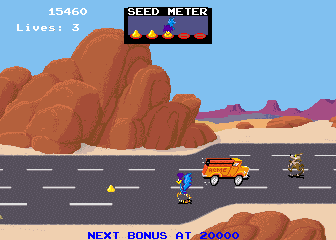
Number three goes to the Road Runner game, with good reason. It’s a boring collectathon that would put you to sleep faster than the truth driving simulator did for my buddy who had insomnia. It’s somehow more boring and repetitive than Frogger yet with tighter controllers and and unreasonable detection for picking up items that it gives me the same sort of anxiety for when I’m trying to color in between the lines. Also hearing the “meep meep” of road runner is so butchered and bastardized that it makes me want to go back 10 seconds into the past so that I never heard of this game.
Number two goes to Journey, the video game. The game is so bland and unoriginal to the likeness of the band that whoever developed the game took the idea of what music literally and didn’t try to do anything clever or unique with it. Doing things like “oh they’re a band so let’s have band related things but not unique to Journey” and “oh let’s have the 16 bit renditions of the songs”. Oh there’s a singer so let’s have a microphone for a weapon, or a guitar or piano as well. It doesn’t do anything special with it, nothing unique to the band for the weapons, they simple put the instruments in there as a way of saying “look a game about music” The execution is so bad it’s laughable. With each instrument collected making horrible noises from the machine and the renditions of the songs sounding like something that was thrown into a garbage collector for songs and then spit out, it’s something to avoid entirely. Not to mention the levels are incredibly short, the whole game lasts about as long as a Super Mario bros speed run (a little more than 5 minutes) and the levels are about as satisfying to complete as unwrapping a a frozen pizza when you’re in walking distance of a pizzeria chain restaurant. In other words it’s very unsatisfying.

Lastly we have educational games. Another Pac-Man one. “oh but Arcademia, that’s unoriginal having two games featuring the same character in one blog post!”. Well that’s too bad really. The problem is that many educational games try to latch onto popular characters like Mario or Pac-Man to make the game more appealing to try and draw the younger crowd in. It’s funny to think about really, I play video games because I want to have fun and not think about school or responsibilities yet video game companies will then use characters I like to then make me try and do something educational. It’s absolutely diabolical, but clever. Too bad it failed.
The game specifically is Professor Pac-Man. A simple game mostly built for what easily seems like 5 year olds and below. The other problem is that it’s two player which means you have to trick a friend into playing it with you. The point of the game is simple enough that a 5 year old can do it. Simple match stuff with the correct answer and do basic problems. The game itself was so bad only 400 units were ever made, with three different revisions for kids, family, and bars or other public places. It was a terrible flop, no surprise. The bottom line: video games and education don’t mix.

So what did we learn from this? Arcade games have many great hits but also can be deceiving in looks just because it has something you recognize representing it. It’s always important to have someone else’s opinion on the game or to even watch the demo footage before potentially wasting your precious quarters.
That will conclude this week’s post, if you enjoyed it as always be sure to come back next week to the Arcade Academia, where I will take a look around the world to see what arcades were like in other countries, if they even had a golden age just like the U.S did and if they still exist.
 arcademia.home.blog