I’m sure many of us can relate as kids: you see an arcade machine, you run over to it while your parents are in the checkout line at the grocery store, your dad is bowling and there’s an arcade machine in the corner, or- you get the idea, some point during our childhood we were out some place, and found an arcade machine tucked away somewhere. Not all of them were great though, and I’ve mentioned something like this before. I remember being at a Marc’s once as a kid, and granted I have rarely played a bad game before. I’ve mentioned it before, Dragon’s Lair(go check it out in some of the worst games to ever be made). The original arcade game was basically an entire movie of quick time events, pressing buttons in the correct order to make sure your 50 cents didn’t go to waste. Thankfully someone else had put a couple quarters in, realized how awful the game was, and walked away, leaving an unfortunate kid like me to experience what a truly terrible game would be like. The controls were stiff, sounds were terrible and graphics were not much better. It was an honest to God mess.
As a young kid you’re kind of ignorant to the world with things going on around you, that day made me realize something very important about my life as a young gamer: there exists bad games. It’s a rather confusing thought as a kid when you grow up with the likes of the Playstation 1 or the Super Nintendo with such great games to represent each console.
This lesson made me realize something important: spend your money well (which already was drilled into me constantly at such an early age by my parents, even when it came to spending 25 cents on candy). But how was I able to distinguish a good game from a bad game then, especially when it’s an obscure title like ones I’ve talked about in another post? (oooh, nice shameless plug there) There’s easy ways of checking a game out before spending your hard earned 50 cents you got from your parents while you were bored at some place.
Simply watch the demos first, it can easily reveal a lot about a game. Also helping to know different genres of video games can help. Just like when I first saw Ninja Baseball Batmen (a game I talked about previously in another post!), the demon revealed a couple things: each characters strengths and weaknesses, as well as gameplay of each character working together. It was obviously a beat’em up game, which are popular and can be hit or miss depending on the difficulty. Should you spend your 50 cents on it? Yeah, I’d say it’s safe to use it on most beat ’em up games.
Side Scrollers are another popular arcade game, very similar to beat’em ups because of the similar mechanics, but more about platforming and traversing through levels with jumps and timing rather than the focus being to beat up as many enemies as possible. Some could be difficult and deceiving like Ghosts and Goblins, a game I can vouch for being very difficult. Others could be as simple as a Super Mario bros. Should you use your 50 cents on side srollers? I’d go ahead and say yes again, because most arcade side scrollers were generally enjoyable to play, very few being bad.
Another common arcade machine to see is racing machines. Simply put, yes, spend your 50 cents on those. Most you see are either the same or variants meaning if you can play one, you can play them all and it just comes down to memorizing the map at that point. I’ve probably spent the most of my money on these types of games just from the frequency of seeing them.
That’s all for today, I hope you enjoyed my story time rambling, be sure to check out my other post that I did today about Easter Eggs to celebrate the holiday and be sure to come back next week, where in one of my last posts I will dive more into my own personal opinion (and probably get a lot of disagreements) about my favorite arcade games! Happy Easter!
Happy Easter Everyone! I originally didn’t plan to do this post, and instead had something different planned, but with the holiday today I figured it would be a perfect change of schedule to include something more interesting than what was originally planned and talk about some of the Easter eggs hidden in arcade games.
For those who are new here, I don’t mean literal Easter eggs, what I’m referring to is hidden secrets that are usually difficult or make the player go out of their way to find, and are hidden by the developers as either hidden features or sometimes jokes.
Namco was notorious for doing small Easter eggs in their video games, doing things such as having to do ridiculous button combinations in order to reveal hidden messages. This was done for games like Pac-Man, Galaga, Dig Dug, and similar titles made by the company.
Mortal Kombat
Another popular series, mortal kombat, supposedly helped popularize Easter eggs with the idea of hidden unlockables, such as the character Reptile.
Mortal Kombat Characters in NBA Jam
Another popular Easter egg was in the game NBA Jam, a personal favorite (and literally the only) sport game for the NES where a hidden Easter egg was being able to play as some of the Mortal Kombat characters rather than the regular teams on the rosters at the time. An interesting thing about the arcade version as well as the addition of more voice clips than the SNES version.
There’s other Easter eggs like in Donkey Kong 3, where the baby Kong is hidden unless you reveal it using a special emulator.
Baby Kong not revealed in the original release
Baby Donkey Kong, visible.
There are many more not listed out there, it’s very apparent that very few Easter eggs existed in the days of the arcades, with the idea becoming more popular in the days of home consoles such as with the PS1 era. I hope you’ll think back to games you’ve played or look out next time you play an arcade game for something hidden that may not normally be there in an arcade game.
I remember once I was listening to music from a game called Metal Gear Rising Revengeance, a 2014 title that was brought over to the PC from console. Why do I mention this? Because the music is some of the best of its kind, symphony rock, and a whole lot of it. One day I went onto the notorious site 4chan, but not to the part we think of when we think hackers and people who you think could destroy your life from a computer screen, no. I instead went to a different part of the site to discuss something lighthearted that we could all bond over: video game music. I start off by saying I was listening to Metal Gear Rising’s music, where the small forum I created turned into this big nostalgia trip for many, saying they were listening to many of the Super Mario soundtracks, Donkey Kong Country, Super Mario 64, sonic the hedgehog, and countless others. It got me feeling nostalgic, I began pulling up playlists of the All-Stars Super Mario tracks, Donkey Kong Country, Mega-Man and one of my personal favorites, the Mighty Morphin Power Rangers soundtrack. Bandai in my opinion, crafted to perfectly capture the feel of each stage, from the upbeat city streets to the gritty songs of the sewers you work your way through. It brings me back to a time where I would listen to those soundtracks at my part time job just to pass the time, or more importantly as a kid when I would play that game all the time. And that’s not to say that only happens with that game, Super Mario’s music brings me back to when I was much younger, when gaming was all I had to worry about (and 5th grade math) and always trying to beat the harder squeal, The Lost Levels. The music was the same, but the world was much different. I died a lot, obviously, so hearing the same tunes over and over made me appreciate every note (and hate) the shear amount of times I listened to them over and over due to having to replay the later levels so many times.
While there are dedicated lists and numerous posts that clearly state what games are better than the others, it’s harder to narrow it down to music, because a single game could have as many as ten or twenty different tracks to choose from. On top of that, many different game soundtracks appeal to different people, rather than the game as a whole. It makes it hard to find a list of just arcade games, rather than a list of specifically games from the arcade era. There is a plethora of lists for 16-bit games in general, but I don’t talk about 16bit games specifically, I cover any game that at one point had an arcade counterpart.
I figured I’d keep this post simple due to how difficult it would be to try and make a post based solely on music from games that may or may not have arcade counterparts, and instead share a story that got me feeling nostalgic(and maybe have you think about some of your favorite classic game tracks), rather than just solely give my opinion on what I think are my favorite, I’ll save that idea for another day.
I may have mentioned this story before (or said I would mention it when the topic is more relevant). I remember back from when I first turned 21 and went to my first barcade. Seeing many of my favorite 16 bit games and also having a couple drinks with friends eventually lead to my eye being caught by a big dark billboard with names of games, and more importantly, the names of people with their high scores. I looked through the list, not every game for sure was on there, but one I knew very well and have mentioned many other times was.
That game was Dig Dug, and only within the last year have I looked up strategies and began to practice to improve my scores, as futile as it was. The best I could do was possibly 80,000, a respectable score but the high score on that billboard was 180,000, a 100k difference.
While I may be far away from my goal, that doesn’t mean if I couldn’t ever obtain it. The great thing about these older arcade games is that if you work hard enough and develop a strategy, you can easily beat those high scores. You won’t be able to do it in a night, but with enough dedication you could in maybe a week or two.
For some reading this they’ll never want to dedicate time to a game like that, where others such as myself want that glory of their name on the board, being able to hold some sort of prestige that few others can.
So, with that out of the way, let’s go over some of the popular arcade games high scores and how you may be able to improve your own to climb the ranks, whether you’re a newbie who’s never really been into games but you were dragged out with your friends to somewhere like a barcade or you’re the hot shot of your group wanting to take it to the next level. Let us begin.
Dig Dug
While still on the subject, let’s talk about a strategy for Dig-Dug. It’s simple really: group enemies, smash them with rocks and make sure to use at least two rocks for the hidden vegetable for bonus points, if you can’t group them up then kill them normally. This game is much more strategic as I’ve said, with the next game we talk about having three patterns of different difficulty up until the later levels, where Dig-Dug can be more random with no solid strategy for clear victory every time, the next game can have a much clearer strategy.
PAC-man
PAC-man will be the second game we talk about, I’ve mentioned this game a couple times before and for good reason: it’s iconic and super fun for just about anyone. You want to get better at it? Little did I know until writing this post, there are actually three different patterns, all involving the same route but accommodates to different situations such as different ghosts. Pattern one will easily get you through the first level, the focus is to clear out the bottom from left to right, grabbing the power pellet in either the left or right corner, and then clearing out the middle and top right side. Pattern two is similar and will get you through the next two or three levels, the only difference is that when you go right, you’ll want to turn the other way as a blue ghost will be after you. Simply turn around, and grab the left power pellet to have him and the others run while you begin to clear out the middle and head for the top right again.
The third pattern is kind of hard to explain, but it involves going around the whole map while tricking each of the ghosts into grouping up, starting toward the center, going toward the top left and clearing out the top right, going back down through the middle and around to the top right, and then down, tricking the ghosts into splitting up and allowing you to have four separate corners with four pellets. There are videos that can help a bit more with this is you want to dedicate time outside of this post, this is just to have some quick information on hand.
Galaga
The next one I want to talk about is Galaga, another popular and easy game to get into. There is a secret that few know about, one that will allow you to disarm the enemies in Galaga in order to get further than ever before and to play as if it’s still level one. Your friends don’t need to know, and if you’re not very good at video games it’s a fun trick to play on them, as they see your score climb higher and higher and watch you get further into the game but yet make it seem as though it’s one of the first times you’ve ever played. There is the method as well as to getting two ships at once, however if you want to risk one life for the sake of dual fire power and have the enemies not shoot you, go for it.
Donkey Kong
Another game to talk about is Donkey Kong. I’ve mentioned it before as being a slightly more difficult game, especially if you try to rush. The very first level is a huge deception to how brutal the game can truly be, especially when you realize if you fall down from large heights it will kill you, meaning you have to time jumps between barrels and holes in the platforms. There are some strategies for different levels, including to clear our one side of yellow markers so that way you can trap flames on the other side of the stage, on top of strategies like getting to the hammers as quickly as possible in order to clear the stage somewhat faster or to avoid hazards that would appear if you went a bit slower through the level. Having a plan for this game will surely help your first couple of times to increase your score and impress your friends(it should as hell would impress me, I’m terrible at this game so I’d be damn impressed).
Lastly I’ll talk about Mario Bros, the original arcade game. This game I talked about in a previous post saying how it was one of the best arcade games and how you could play with a friend to help or hurt them, and that’s basically the strategy here. Help your friend, steal their points, kill them off or take their kills after they knock enemies down. Do whatever it takes, fight fair or fight dirty. If for some reason you’re playing alone however, I used to play this quite a bit on the hand held consoles. A big key to this game is just management of the surroundings. Learn how each enemy works and which you should deal with first. Turtles are the least of your problems when you have angry crabs or angry bees after you. Never be comfortable in one place, be used to being on the bottom, middle, or top parts of the stage, as some parts may turn to ice or have fire balls that will kill you on contact. More points means more lives though, so like I said: manage enemies, grab coins for extra points after killing each enemy, and be comfortable at any part of the stage and you’ll be impressing your friends in no time. And of course, your saving grace: the POW block to help you knock down enemies to easily clear levels. However it only has three uses, so be careful.
That’s it for this post, I will be doing another one hopefully tomorrow about some of the best music from the best arcade games, and maybe some of the home consoles as well. That’s it for this post here at Arcademia, the Arcade Academia.
So looking back at my first post about the history of arcades (shameless plug, I know), I only really focused on the U.S’s golden age of arcades and the birth of gaming itself. However I didn’t focus on the rest of the world, with many of the games we saw in arcades coming from primarily Japanese companies and manufacturers, what was it like for the rest of the world, and what was it like for Japan, the place that seemed to be making all of these amazing arcade games? Here at the Arcade Academy, I’ll be taking a closer look as to what happened back then and how arcade games hold up now.
So I apologize yet again for posting so late, as one of my siblings flew into town for their spring break that I don’t see very often. The other unfortunate news when researching this topic is that it will be my shortest post yet, I may not even have pictures for it.
So the idea of arcades in Europe, Asia and even Japan I thought there would be a lot of interesting things to talk about, different ideals of what should be in games, PAL versions, outrage. No, none of that actually. Instead we look around the world and even in Japan where many of these games were made we see a very similar history to ours. Japan used to have many arcades, as many as 40,000 but now they barely hang on to existence, unlike in the U.S where we still try to preserve their memory and having arcades actually make a comeback. The same goes for Europe, they also have their own version of the biggest arcade known as Boing Boing, an odd name but impressive none the less that someone in Europe would have the same dream of preserving the idea of arcades like in the U.S. The only thing that really stood out was Russia, with the mention of them making Soviet Union games that could be played, which is rather humorous to think about, games based around the Soviet union with heavy ideas of communism and hatred for capitalism and the U.S. I can’t imagine they were very good, but still a piece of history that needs to be preserved.
Well I guess that’s all for today, be sure to come back next week when we talk about a more interesting subject, the different kinds of music, the most popular of its age, 16 bit tunes that we could still listen to today and love them. I hope you enjoyed this shorter post and hoped you learned something at the Arcade Academia, see you next week.
Welcome back everyone and I apologize for the delay, there was this tornado warning and I was volunteering to help with damage that was caused by the strong straight winds that came through.
With that out of the way, today we’re talking about the best and worst of Arcade games, a very brief guide to some of the worst games out there that you shouldn’t bother with if you find yourself at an arcade or old bowling alley with a game in the back that could either eat your quarters or gave you a couple hours of entertainment.
So without further delay to a simple list of games, I’ll simply do 5 of the best and 5 of the worst, to keep things simple and because you’re very unlikely to see one of these bad games compared to the many popular games that are much better in quality.
Starting with the best games at number five we have Dig-Dug. I’ve talked about this game in the past. It’s different compared to others which is why it’s so low on this list. Compared to something like a racing game that anyone could pick up in a couple seconds or pac-man which is easy to understand, the idea of having to move around, making sure not to get smashed by rocks, keep track of the increasing amount of enemies that also get faster, and first time players or intermediate players still not having any sort of strategy to consistently get better, it’s definitely a more challenging game.
Dig Dug
The object is simple: dig through and pop enemies, score points, gloat about your score. This is personally my favorite arcade game, with my goal at a local barcade is me having my name up on the big board they have there. While this game is low on this list for all time best, it’s probably my favorite arcade game.
Next up at number four is Galaga. This game can be hit or miss for some in terms of skill. I myself never score well (the 30,000’s maybe) while my buddy will get double the score with ease. I’m not sure what is it that causes the huge gap in skill, but people out there exist who are just great at this game. That gap in skill is what landed this game in the 4th spot. While the game is much easier to pick up, the risk/reward of getting a double ship for twice the firepower at the risk of losing another life, enemies adopting kamikaze ideals in order to destroy you while also firing at you, the game can become chaotic quickly if you don’t stay calm, have a good aim, and a steady hand.
Galaga
The number three spot goes to the original Donkey Kong. A simple game with a simple concept, dodge, jump, and get the girl back as an unnamed plumber at the time. This game has random barrels, later on fire, jumps across hazardous gaps and changing levels. If you play this game, you probably understand how it works. Most new players wouldn’t jump straight into this game as their first choice compared to others, as it can be difficult. However the object of the game is simple enough that if someone were to walk up to the machine they could clear a couple levels and after getting over would say “hang on let me try that again” because of how fun the challenge that is present can be.
Donkey Kong
Oh look it’s number two, and it was mentioned earlier. That’s right, with no surprise that it’s on the list, it’s Pac-Man. This game is probably the most simple to play of those mentioned this far: collect pellets, dodge ghosts. Just about anyone could do it, it’s not till the later levels when things get faster than you need to have a strategy in mind, but for a kid with a couple quarters, someone who’s never played, or someone who’s had a few drinks at a barcade, it’s fun for everyone.
Pac-Man
The number one game though in my opinion is the original Mario Bros. While it may take a little time getting used to with the slightly slippery controls (which doesn’t help later on in stages that actually have ice), the reason why it becomes number one is because you can get help from a friend! As silly of a reason it may be, being able to get help from a friend is a huge advantage: get farther in the game, fight for high scores, no waiting to take turns. The game is pretty simple and generous, just be on the lookout later on for fireballs that can go across different parts of the stage or the increasing speed of enemies as stages progress. It all becomes much more manageable with another friend to help.
Mario Bros.
Well, now let’s get on to the bad games. Starting a number five is one I never personally heard of but seems to have made many older players mad due to their quarters being stolen. This game goes by the name of Name that Tune. The point of it is to either use one screen hints or sounds the game makes. Probably not the best experience on a 16 bit console with a limited sound range. Granted cabinet arcade systems had better hardware than most home consoles, I doubt it was anything spectacular.
Name that Tune
Number four will be NARC, a beat ’em up game that focuses on killing drug dealers. Sounds decent enough right? Unfortunately due to the lack of making it stand out in any other way other than the concept of being a cop against drug dealers, the game has nothing original to offer other than being released during the time when there was a war on drugs, and instead of drugs ruining lives it was a video game.
NARC
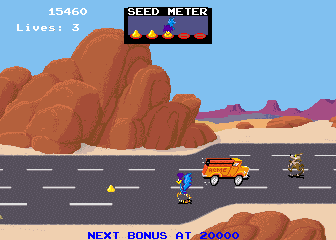
Number three goes to the Road Runner game, with good reason. It’s a boring collectathon that would put you to sleep faster than the truth driving simulator did for my buddy who had insomnia. It’s somehow more boring and repetitive than Frogger yet with tighter controllers and and unreasonable detection for picking up items that it gives me the same sort of anxiety for when I’m trying to color in between the lines. Also hearing the “meep meep” of road runner is so butchered and bastardized that it makes me want to go back 10 seconds into the past so that I never heard of this game.
Road Runner
Number two goes to Journey, the video game. The game is so bland and unoriginal to the likeness of the band that whoever developed the game took the idea of what music literally and didn’t try to do anything clever or unique with it. Doing things like “oh they’re a band so let’s have band related things but not unique to Journey” and “oh let’s have the 16 bit renditions of the songs”. Oh there’s a singer so let’s have a microphone for a weapon, or a guitar or piano as well. It doesn’t do anything special with it, nothing unique to the band for the weapons, they simple put the instruments in there as a way of saying “look a game about music” The execution is so bad it’s laughable. With each instrument collected making horrible noises from the machine and the renditions of the songs sounding like something that was thrown into a garbage collector for songs and then spit out, it’s something to avoid entirely. Not to mention the levels are incredibly short, the whole game lasts about as long as a Super Mario bros speed run (a little more than 5 minutes) and the levels are about as satisfying to complete as unwrapping a a frozen pizza when you’re in walking distance of a pizzeria chain restaurant. In other words it’s very unsatisfying.
Journey, the Video Game
Lastly we have educational games. Another Pac-Man one. “oh but Arcademia, that’s unoriginal having two games featuring the same character in one blog post!”. Well that’s too bad really. The problem is that many educational games try to latch onto popular characters like Mario or Pac-Man to make the game more appealing to try and draw the younger crowd in. It’s funny to think about really, I play video games because I want to have fun and not think about school or responsibilities yet video game companies will then use characters I like to then make me try and do something educational. It’s absolutely diabolical, but clever. Too bad it failed.
The game specifically is Professor Pac-Man. A simple game mostly built for what easily seems like 5 year olds and below. The other problem is that it’s two player which means you have to trick a friend into playing it with you. The point of the game is simple enough that a 5 year old can do it. Simple match stuff with the correct answer and do basic problems. The game itself was so bad only 400 units were ever made, with three different revisions for kids, family, and bars or other public places. It was a terrible flop, no surprise. The bottom line: video games and education don’t mix.
Professor Pac-Man
So what did we learn from this? Arcade games have many great hits but also can be deceiving in looks just because it has something you recognize representing it. It’s always important to have someone else’s opinion on the game or to even watch the demo footage before potentially wasting your precious quarters.
That will conclude this week’s post, if you enjoyed it as always be sure to come back next week to the Arcade Academia, where I will take a look around the world to see what arcades were like in other countries, if they even had a golden age just like the U.S did and if they still exist.
Not all games get to have a console counterpart, nor were there promises of them ever being popular, whether they didn’t do well in the U.S Arcades due to not many arcade machines being in the U.S or were never ported to console to gain notoriety.
So here I will talk about some of the obscure games of different genres as well as my personal experience with one very obscure game. The reason why you need to play them (if the point of my blog which was to encourage you to play them in the first place for yourself, I hope this will make that message more clear this time).
So there’s too many games to count based on research that I’ve done, instead I’m going to keep it simple for myself and for all of you, to give you a base idea as to what is really out there, where to start in case you want to explore for yourself. I’m going to cover popular genres for arcade games: racing, fighting, and beat’em ups. If I tried to do more than just those three, you’d tell people never to read my blog because of how long the posts are.
First up is racing games, with a company I mentioned in my first post(which you should read, don’t ignore this), Taito’s Speed Race released in 1974. Credited with potentially being the first controllable racing game where you use a wheel rather than a traditional controller or joystick, it must have been such a huge innovation released during the golden age of arcades. The objective, like many games of its time, is simple. Dodge cars, get a high score!
Speed Race
Next up, Death race. Imagine GTA but you’re always in the car, and the object is just to hit people. There you go, simple enough, NEXT.
Death Race, every cross is a grave marking where you ran someone over.
The writer that wrote about Death race needs to be shot, fired, or damned to one thousand years of bad video games for that horrible description. Anyway, the next game is called Night Driver. For an arcade game, it’s decent due to how simple it is, being that you just need to avoid crashing into things. The only problem is that the sounds it uses will make you wish you were born deaf. It reminds me of some games that were released during the early days of iPods, where you did similar motions by tilting the device back and forth.
Night Rider
Lastly we have Le Mans 24, which seems to be a cult classic among racing game lovers for the arcade. It seems just to be your standard racing game with many different iterations, including an arcade version, as well as a Sega version featuring many different cars.
Le Mans 24
Next we have fighting games. It was hard back in the day I’m sure for a new fighting game to rise up when there was already well established franchises in the form of Street Fighter, Mortal Kombat, or Tekken. Turns out there’s many others that were praised, and others that may have been loved out of nostalgia.
First up is Kaiser Knuckle, released in 1994 by Taito this game was meant to be a clone of Street Fighter II, with it’s own twist on the fighting mechanics. The only problem is that it released 3 years after Street Fighter II, so Kaiser Knuckle never caught on.
Kaiser Knuckle, the resemblance to Street Fighter II is very apparent.
Second will be Dragoon Might, an arcade only release that featured many different interesting mechanics including the use of weapons as the primary way of doing damage. So imagine Street Fighter II, but the only way to do efficient damage is if you have a weapon. You can fight with your fists, but it’s much less ineffective. You can also disarm opponents as well, so you’re not always going to be safe! The game also has an interesting risk and reward system with the special attacks: time it right for big damage, miss and you may end up killing yourself instead of the other player. I’m sure because of this game being arcade only is why it became obscure like many others, this is a game I will have to take a second look at.
Dragoon Might showing off two sword users
Lastly we have Outlaws of the lost Dynasty, which I would recommend playing in an arcade if possible. The reason? It has overwhelming positive support, however a main complaint is that it is very similar to other fighting games of its time, meaning that it isn’t necessarily worth buying a Sega or PlayStation(unless you already own it) to play it. A big difference between this game and Dragoon Might is that while they both use weapons as a means of attacking, using your fists gives you a different system rather than being punished. Swords give fast strikes but are harder to combo with, where bare fists give less damage but much more combo potential. Like Dragoon Might I will have to come back to this game as well.
Outlaws of the Lost Dynasty, featuring one character with weapons and one without.
Lastly we have the popular genre known as the beat’em ups. The classics like x-men and turtles or even the Simpsons’ create this sort of standard as to what a beat ’em up should be like. Some of these hit the mark, with one special game being a personal favorite, which I’ll eventually get around to and oh boy, the list of beat ’em ups is about that of a short novel.
First up for the beat’em up is Shadow Force. This game was also made by the same people who developed the popular Double Dragon beat’em up game. The difference? Six buttons instead of four. Why is that significant? Well it allowed for the player to do things such as low attacks like a fighting game and even allowed the use of blocking. A problem I had with this game was that it was hard to tell which character was the player when the screen was more crowded.
Shadow Force
Second up is The King of Dragons, which is essentially the famous Dungeons and Dragons brought to life in the form of a 2D beat’em up. There were many like it, but this one seemed to be the most talked about in forums and other blogs. An interesting mechanic for this game is that you’re able to level up, allowing you to gain more health on your journey and unlock spells.
King of Dragons, a Wizard attempting to take treasure from Goblins
Last but not least is is a fun game I played back when I was very young, I’d say about 7 years old. I went to a bowling alley and they had this little arcade game that looked a lot of fun. This game is known as Ninja Baseball Batman, and according to sources there was only ever 43 of these arcade units ever found in the U.S. As someone who enjoys a once in a lifetime opportunity, I’m glad to know that was one of them.
The game itself though, well the title speaks for itself really. They’re ninja batmen, in this what I can only assume an alternate version of Japan where baseball rules over everything. And frankly, I’m okay with that. It has your standard characters: the all around good choice, the speedy character, the power character, and the character with the long reach, all with their own unique and special moves with even more unique levels and enemies. The idea of the game is simple: someone stole baseball artifacts and your job is to retrieve them. Simple enough, simple but captivating game play. Don’t let my words fool you. I may say the game is simple, but finding the game won’t be. Considering it never had a console release, the only way to play it now is to go somewhere like the biggest arcade in the U.S, which I mentioned in another blog post(shameless plug, sue me) or emulating it online or what I recommend it is downloading it, as playing it online has a lot to be desired for sound quality.
Ninja Baseball Batmen, featuring a boss that is a plane, being fought inside a bigger plane
That’s it for this week, I hope you enjoyed as always and consider subscribing for more. Unfortunately I will be taking the week off so come back in two weeks (March 14th) for the next post!
So, I’ve covered two essential topics so far: the golden age of arcades, and then where arcades are now which have mostly come back in the form of barcades. In my first post I went into more detail as to why Arcades began to fade away, but the reason that is relevant to this post is the innovation of the home console. the NES, or the Nintendo Entertainment System, was revolutionary. Just think about it, the idea of buying the game once and you owned it to play whenever you wanted in your own house. In some ways it was vastly superior than having $10 in quarters making your pants sag a little lower while you jingled over to the arcades. Today I want to talk about the differences that were seen between games on the Arcade machines vs those on home consoles.
The NES has many great games with what some consider, superior counterparts. Some like the superior sound design of beat ’em ups from Turtles in time or X-men and experience of just being in an arcade. Turtles in Time had voice acting, compared to the text boxes that were in the SNES port, among other small character sprite and menu changes. Then there’s others that have the game slightly altered like the original Super Mario bros to prevent exploits such as ways to obtain infinite lives to manipulate the score board.
That was the exact experience I had at a local arcade one night, I was attempting to be a hot shot and make it to the top of the score boards, when I noticed certain enemies were missing. This was again, done to prevent cheating in certain parts. There were also jumps that were slightly modified to be more difficult. On top of that there was also some minor differences such as power ups being moved, replaced, or removed entirely from levels.
Some have reported that games like Turtles in Time, while they may have a better soundtrack on the arcade cabinet, it lacked the refinement that the port did. For example it has stated there is unfinished animations or glitches when fighting enemies.
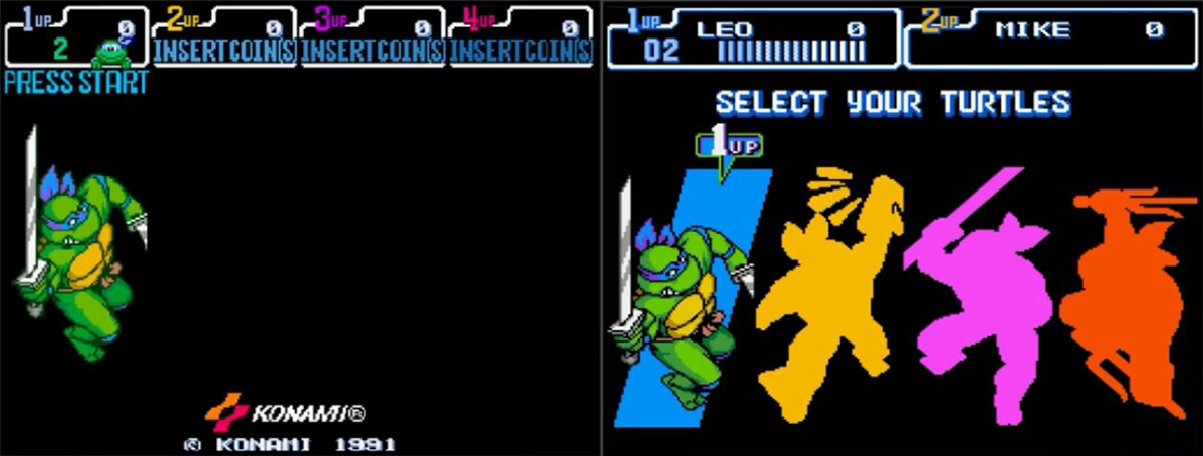
One of many details changed in Turtles in Time, the player select screen.
The next point I find a bit controversial because of the passion in the community, but there is a debate for fighting games as to which may be superior. Some games such as the original Mortal Kombat or Street Fighter 2 are debated as to whether they’re better at the arcades or on the home consoles, with some stating that they both have wonky controls that don’t work well on the big arcade systems(which wasn’t an issue for sequels)or the NES and SNES inferior sound and sometimes inferior graphics, as both fighting games did not have the glitches that Turtles in Time did.
Even some games such as Tekken Tag Tournament were running on PS1 hardware in the arcades, where the port was released on the PS2, the next generation console of the time. It boasting better graphics and tighter controls. Mortal Kombat had many changes between the Arcade and the SNES port, the Sega Genesis remained faithful, even going as far as to not change some of the odd animations that would raise an eyebrow due to how unnatural they looked. Graphics aren’t everything though! Another popular fighting franchise, Soul Caliber, was the exact opposite, despite releasing on the Sega Dreamcast, a rival system to the PS1, PS2, and SNES, was inferior due to the worse controls which made it an overall inferior experience.
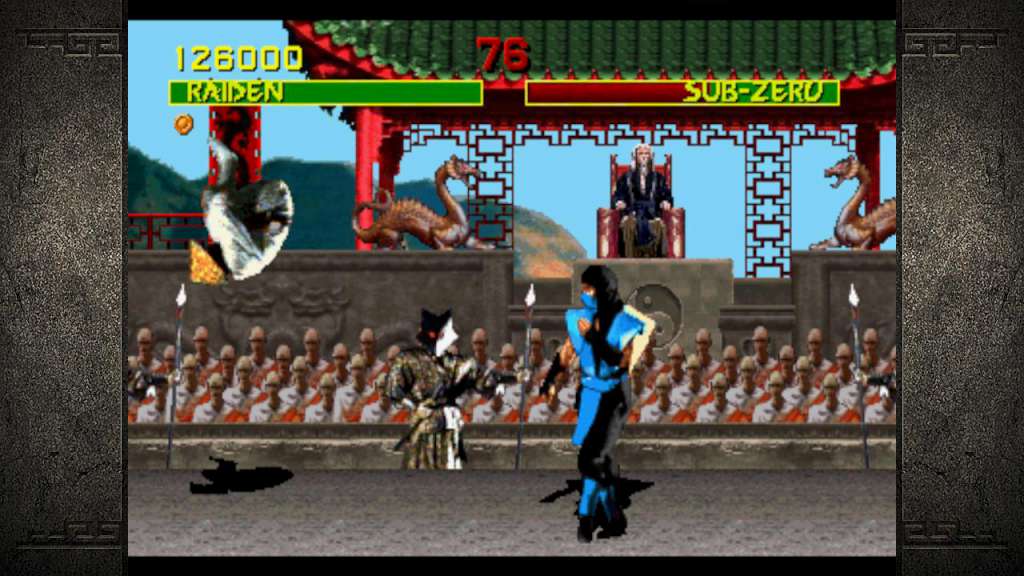
Mortal Kombat with several changes, with the Arcade on the left and SNES port on the right, featuring lower detailed graphics, different fonts and foreground, among other changes.
A special type of game as well, one that was terrible, were games that were made into literal random button sequences. These types of games would be merely made into cut scenes, and would want you to press button combinations at random times. Some were ported to the NES,SNES, and the SEGA CD as completely different games(and they weren’t much better). The best(and maybe only) example is dragon’s lair. I had the chance to play it at a Marc’s once, and the stiff controls and dying in one hit made it an unpleasant experience very fast. Bottom line: don’t play any of them to retain the most sanity.
Top: NES, original arcade quick time Bottom: SEGA CD, SNES
There are many more games that have got either faithful ports from the arcade or entirely different games all together, however I think you get the idea: The idea of Arcade vs Console is for the most part subjective, with some people despite the issues the arcades had, still going to play them because it is nostalgic and holds many more memories and allowed them to connect with strangers, where others prefer the home console port for the sake of being convenient, but if it was better that is always a plus.
I hope you enjoyed and got a solid understand now that not all arcade games were the exact same as their console counterparts, be sure to come back next week where I discuss games you may or may not have known about due to their obscurity, good or bad.
And for those of you that were curious about the location of the arcade in the Waldo picture, here it is. Be sure to check out my Instagram for updates for the next post!
So now that I have taken the time to go over the basics of arcades, where are they now? Where have they gone? Well, I can say for sure some have endured the test of time while others have adopted the barcade scene and locking people out who are under 21. I plan on going over the best of both, considering before I was 21 and angry that I couldn’t get into a local barcade that had just opened in a nice part of town.
So here’s the thing, my blog is focusing on video arcade games, not other games such as pinball machines. So unfortunately I will not be talking about the Las Vegas Pinball Arcade in much detail, beyond this mention.
With that out of the way, I’ll keep it short and simple, here’s some arcades you should visit at some point. Keep in mind as well these are all based on research, I have not been to many of these myself unfortunately.
I’d be embarrassing myself if I didn’t start with the biggest and best of the arcades (otherwise people will probably think it isn’t in this list, and will just scroll through till they find it, only finding the information they want/need. Then leave. )
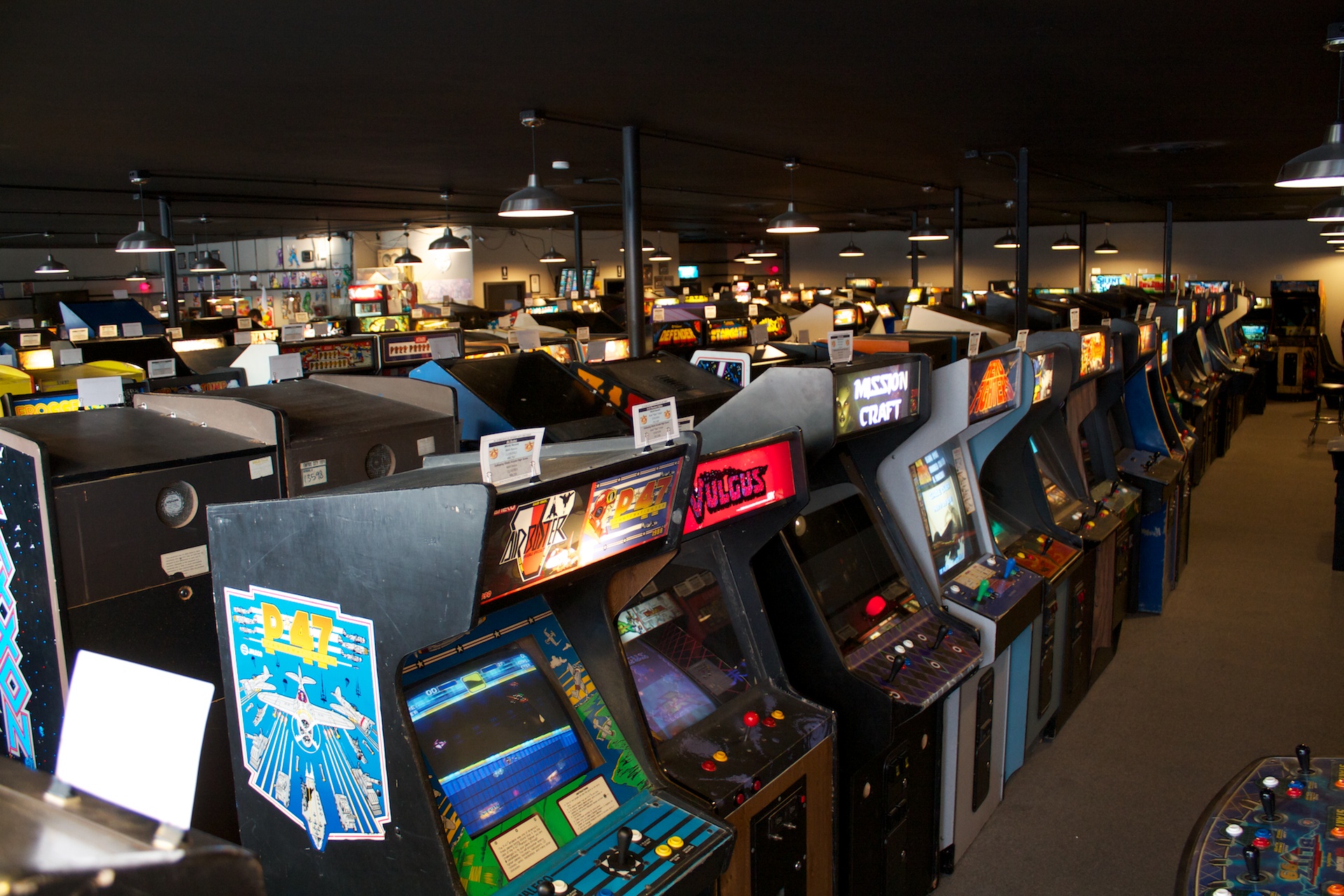
The first to be mentioned is The Galloping Ghost Arcade in Illinois. This one has opened in the last decade surprisingly, and according to their site they were able to save an initial 150 games from destruction when they first opened, and now have more than 500 games available. I could only think of all the lost treasures in that place to potentially blog about…This arcade has you pay a one time fee and you get to play all day, which only makes me want to visit this place even more.
Galloping Ghost Arcade
Next up is New York’s Barcade(yes, it shares the same name as the term used to describe bar arcades, what a coincidence)! Every time I see this one I get a speakeasy, underground feel to it, you know? I’d go to this place as a regular if I could over Galloping, while it may not have as many games, the vibe looks a lot more enjoyable. Unfortunately, it’s locked out to those under 21 as it does serve alcohol.
Barcade
Next up is one for the West Coast people, however this one is also locked out to 21. This one is in Las Angeles known as Button Mash Arcade. The scene here looks to be more so bar than arcade with its cleaner aesthetic, but I’d still go regardless.
Button Mash
Next is the oldest Arcade in America, for all ages thankfully. Known as Spring Lake Arcade in Rhode Island, it has been around since the 1930’s, sporting a wide variety of arcade games that you can play for as little as a penny. I’m not sure how much fun that would be, but being able to go to place that holds such a unique piece of history in the form of arcade games? Sign me up. This was once a beach dating back to the 1800s interestingly enough.
Spring Lake Arcade
Another West Coast arcade, in San Fransisco CA. This is simply called Coin Op, another barcade, and that’s such a humble name for an arcade that is able to blow me away with not just its pictures but also its website. I’m not even being paid to say this, but the site itself with the little bits of attention to detail was enough to make me fall in love. They have a big page on their site to show off all their games, just so you can make sure there’s something you like before going. Not only that, but THE BAR IS MADE OF OLD TELEVISIONS. The little things, I swear. Seems like with anything else with East and West coast, it seems that I’m now becoming conflicted as to what has better arcades now.
Coin Op’s Bar, you owe it to yourself to go look up their arcade.
Last and certainly not least, 16-bit, another barcade. This is probably just an Ohio exclusive, but they don’t slack, especially with whichever location you go to. Whether it’s Columbus, Cleveland, or Cincinnati you get a different experience at each one. I am actually set to visit the Cincinnati one this upcoming May, where it is right in the middle of the bar scene and at least twice as big as Cleveland location. Don’t immediately dismiss Cleveland though. If you’re tired of the drinks or the arcade games, go out to the outside patio where you can participate in Super Smash bros for the Nintendo 64 or Mario Cart for the Gamecube. There’s something for everyone. If you’re in Ohio and appreciate good drinks and good arcade games, this is the perfect spot.
16 Bit bar and arcade
So, where are the Arcades now? All over the place obviously, with my post barely scraping the surface. They’re alive and well, with alcohol! What could be better!?
As always I hope you enjoyed, subscribed to be part of the Arcade Academia, where your journey as well will begin with just a simple button press.
Come back next week, now that I’ve explained the 70’s and 80’s for Arcades, and now where they are now, I’m going to compare some of those popular Arcade games that we love and their home console counterparts. I cannot wait!
In the beginning, there was Stanford University, and they said “Let there be coin based machines” and this was good. The game known as Spacewar, a game where two little paper-airplane like ships controlled by each player would go head-to-head while also avoiding the black hole in the center that would be just as happy to win as much as the other players. Sounds a bit more interesting on paper, huh? In any case, what is known as the very first arcade video game that required coins to play deserves an honorable mention at the least for getting the digital trend going.
That was just the beginning! Known as the Golden Age of gaming in the late 70s and 80s, it gave birth to many companies that some may know today like Atari, Namco, and Taito. With the birth of these companies came revolutionary games such as Atari’s Pong in 1972, a virtual ping pong table game, and on release it was a renowned success. Taito released Space Invaders in 1978, which I myself consider in many ways to be the successor to Spacewar. Namco released their own take on the space shooter genre in the form of Galaxian in 79, Galaga in 81, and Bosconian the same year with all three games being an incredible success. Namco didn’t stop there though, they also have another trump card in the form of a character named Puck-oh wait that’s Japan. Pac-Man, the undying mascot of Namco that has lasted the ages with games as late as 2016 of the yellow video game idol. Imagine hungry hungry hippos but with more ghosts and takes skill to win. There were many other games like my personal favorite, dig dug that may not have been as popular at first, but were unique in its own way that it eventually caught on as another Namco classic.
From left to Right:
Space Invaders, Galaxian, Galaga, Bosconian, and Pac-man
Like the Boom and Bust leading into the great depression, such things happened as well for the arcade game industry. What was once an $8 billion industry was now a little more than $2.1 billion. The reason? Home consoles became more accessible to home owners, along with video games. During this time as well the video game industry itself was in a slum, a depression. Like any depression it takes a lot to get out of one as we have seen previously in American history with our own Economic depression. So, how did we pull out of it? Three words: Super Mario Bros, by the giant known as Nintendo. This game was known for possibly saving the gaming industry during the times of crisis, as well as bringing back life to the arcades.
Why Super Mario? Why not any other game during it’s time? Looking back at a lot of arcade games, ever its predecessor, Mario Bros released in 83, my best guess is because instead of the game being about the high score like many of the space shooters of earlier years, it was about the journey there. Instead of one screen with waves of enemies, or the focus being on how many enemies you can kill and rack up the score, it’s instead about how many worlds you can get through, the hidden secrets across the Mushroom Kingdom’s many pipes and coin blocks, and what prize awaited you at the very end of the game in the final castle.
Super Mario Bros on the left, released in 85, and its predecessor released in 83.
This is unfortunately where I end today’s blog. I want to mention however that many more great games such as Street Fighter II, Mortal Kombat, and Tekken among other fighting genre games were released in the 90’s. This blog post at the least was meant to be an introduction to the early days. I would like my audience whether you’re a first time player and reader or a veteran who probably could’ve wrote this better than myself, to not be left out on the greatest of games that came out, but I just won’t be covering them in this post specifically. This post (I may or may not mention them) will not necessarily focus on console exclusive games until later, if at all.
I hope you all enjoyed, stay tuned for next week when I talk about where arcades are now, why and how some of them have risen once again in popularity, and more! Hopefully some of you will go and try some of these games for yourself for the first time, many of them can even be played in your web browser.








/cdn.vox-cdn.com/uploads/chorus_image/image/49643473/2015-09-04-buttonmash-010.0.0.0.jpg)


 arcademia.home.blog